They made the biggest film of all time around the corner from my place

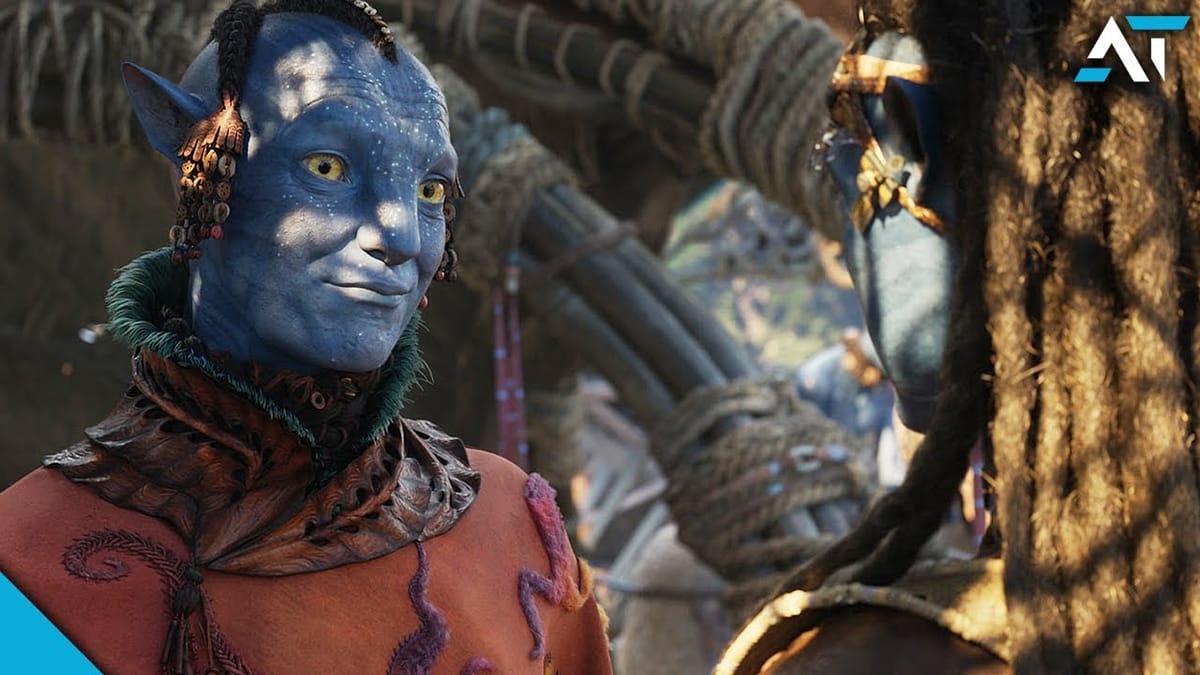
It brings me no pleasure to announce that Unesco City of Film Wellington has once again become the centre of the world with Avatar: Fire and Ash premiering in the Greater Mount Victoria area (i.e. my turf) last week.
This is the third entry in new New Zealand citizen James Cameron's Avatar franchise and by all accounts, it's even more ayahuasca-brained than the first two put together!
Opening your mind to make room for all kinds of blue guys
For the uninitiated, ayahuasca is a hallocinogenic plant native to South America that is typically used either as a sacrament in Indigenous ceremonies or for White guys who need to come up with a new kind of alien. It is rumoured that David Icke supped of the vine to formulate his antisemitic conspiracy theory about reptilian humanoids. I'm not accusing Cameron of using performance enhancers, but he sure did come up with a whole lot of new aliens in the three-year lead-up to Avatar: Fire and Ash[1].
In the first film (2009), Cameron introduced us to the alien race known as the Na'vi, specifically the Omaticaya, a clan of Na'vi that are visually based on Indigenous North Americans. Cameron has mentioned in interviews that he was inspired by the colonisation of North America and stories about that colonisation that center white characters like Kevin Costner's Dances with Wolves. Cameron also cast Cherokee actor Wes Studi[2] as a Na'vi clan leader.
In the second film (2022), Cameron found The Way of the Water and a new clan of Na'vi. The Metkayina clearly draw from Polynesian peoples, specifically the Māori of Cameron's adopted homeland and have a spiritual bond with alien whales called Tulkun[3]. Both the Metkayina and Tulkun wear moko and and star Cliff Curtis helped Cameron develop a Na'vi haka[4].
Now, after just three years, Cameron has emerged from the depths of the Miramar Peninsula and he's brought some friends. Fire and Ash introduces the Mangkwan clan[5] led by evil alien femdom Varang (Oona Chaplin)[6].
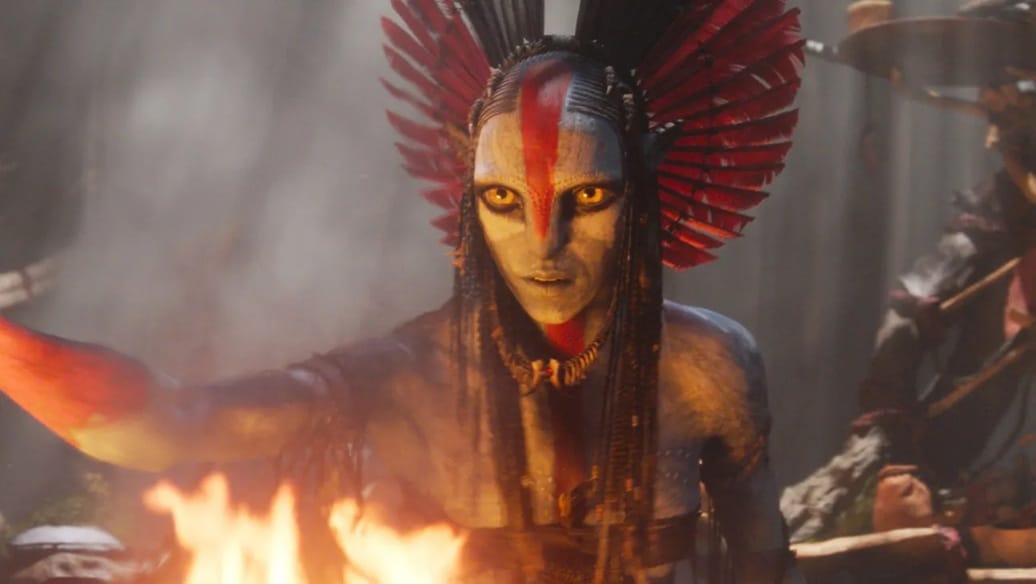
The Mangkwan clearly draw from Indigenous South American nations. They live in the mountains, fight with bolas and wear headdresses that superficially resemble Tupi featherwork. Varang also uses a hallucinogenic drug that she applies via a tepi pipe, much like the one used in ayahuasca ceremonies.
Varang looks great but the design of the rest of her clan is the weakest in the franchise. Covered in ash, they resemble nothing so much as the grey CGI orcs in Peter Jackson's Hobbit prequels. In a series that approaches Indigeneity with the care of a wrecking ball, the human-aligned Mangkwan are Cameron's most half-assed aliens yet.
Archetypes in search of a justification
The idea of an Indigenous nation siding with a coloniser to settle old rivalries isn't particularly novel in and of itself. The relationship between Colonel Quaritch and the Magkwan clearly mirrors historical examples like Hernán Cortés working with the Tlaxcala to defeat the Aztec Empire.
The Mangkwan, however, became evil before their contact with humanity. When Varang was a baby alien, her village was destroyed by a volcano. This event was so upsetting that she changed her entire culture and belief system in response[7]. Rather than worshipping Pachamama like the other Na'vi, she wants to burn everything to the ground.
For Cameron, the archetypes themselves are so important that they replace any sense of in-world logic. He wanted to introduce a people who represent the way that "rage and anger" can undermine environmentalism so he reverse-engineered an origin story, despite it making no sense within the world he's appropriated.
I have always struggled with Cameron's characterisation and dialogue. I love a lot of films where characters are drawn with broad strokes but usually there's an underlying reason. In Avatar the archetypes sit on top of a whole lot of nothing. It's just so dumb!
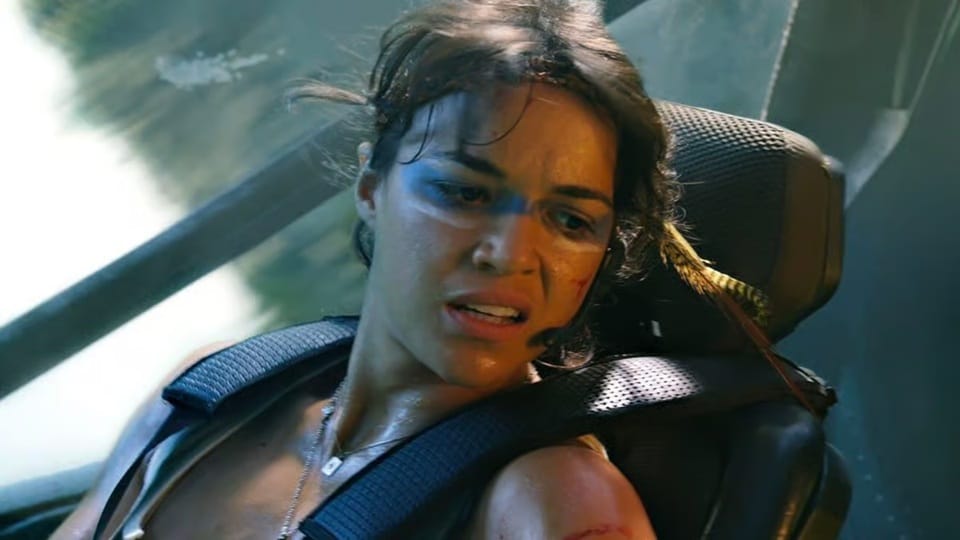
The absolute nadir of the 2009 film takes place when Michelle Rodriguez's character decides to be good and go against the orders of the human military. Why does she do this? What does it say about people working in genocidal systems? Nothing! It's just that Cameron loves a story about a class traitor. Whether it's Arnold Schwarzenegger's face-turn between Terminator movies, Kathy Bates' woke millionaire in Titanic or a moment in Fire and Ash that is identical to the Rodriguez moment, the filmmaker clearly has an affinity for characters who do good despite their privilege[8].
Another bizarre character motivation is the racism of Zoe Saldaña's character Neytiri towards Spider, the human white boy with dreads that joins her family in the second film. From the get-go, she is unbelievably hostile towards him, with every line of dialogue being the kind of first-draft placeholder that Cameron adores ("you belong with your own people!").
Now don't get me wrong, if Spider was in my found family, I'd be trying to kill him all the time as well[9]. It makes perfect sense for a character whose people are being colonised to distrust a representative of the coloniser. But Neytiri's husband Jake (Jai Courtney or something) and adopted daughter are both human as well and she doesn't show any hostility to them. Unlike Spider, they exist in Na'vi bodies but Jake in particular is much more culturally human than Spider. It just makes her character look stupid and irrational.
It's a shame because I'm totally onboard for a dumb action film using broad strokes to argue for decolonisation, but it doesn't land here.
Comrade Cameron?
Even though the Avatar films are kinda lazy and racist, they deserve some credit for unambiguously presenting Indigenous characters who are morally justified in using violence to fight back against their colonisers[10].
There's something admirable about the way the films avoid ideas about inevitabilism. The Na'vi might be based on Indigenous people as-at first contact with Europeans, but their relationship with their material environment mean they're able to put up a fight.
Having the colonisers be explicitly based on the American military is pretty cool in theory as well. There has always been a thread of anti-American sentiment through Cameron's work (think of the anti-LAPD stuff in Terminator 2 and Strange Days). With her kneejerk racism and antisocial prickliness, Edie Falco gives a much better performance as Hilary Clinton here than she did in American Crime Story.
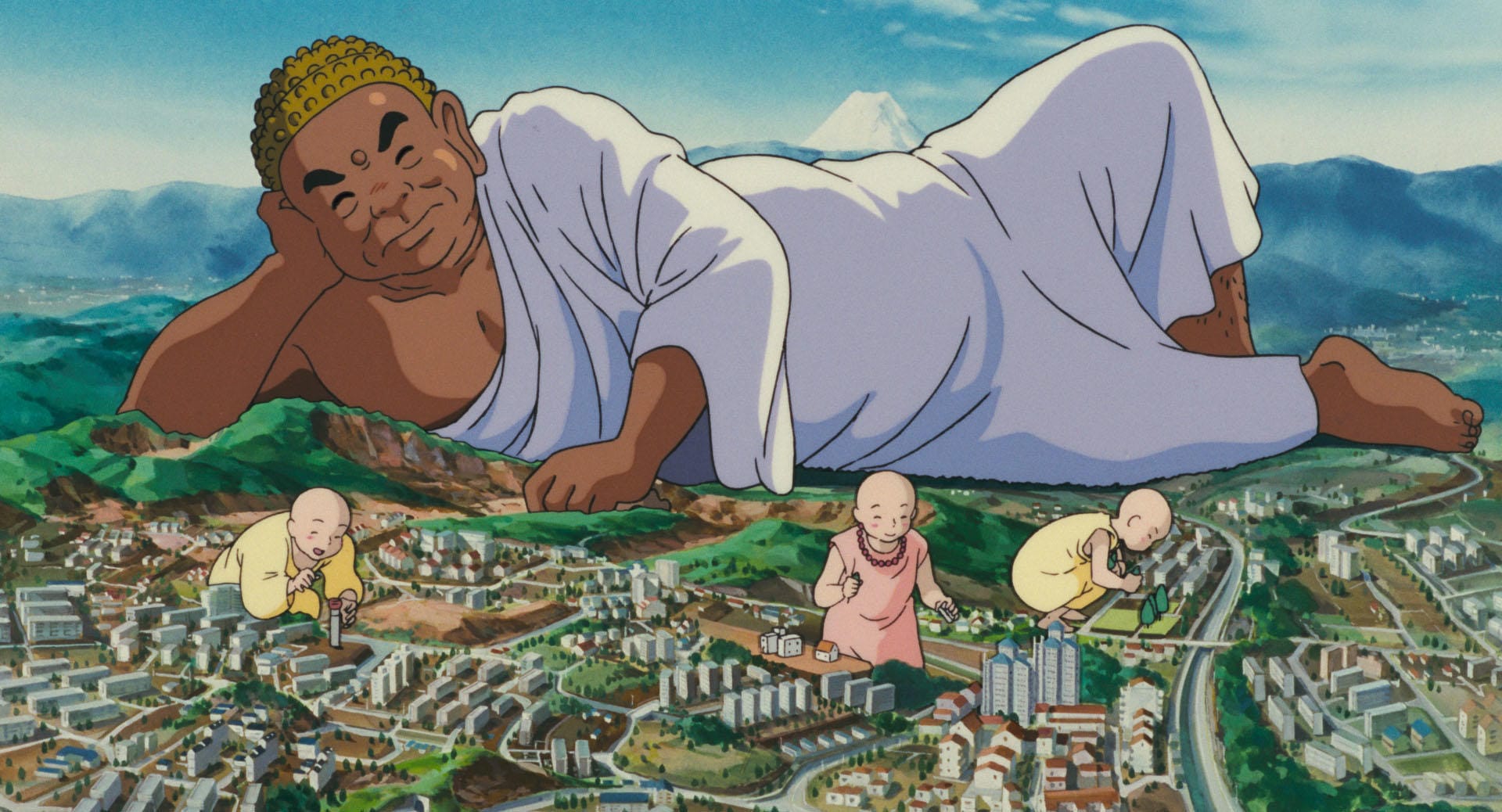
One of the best visuals in the new film comes from the human war room, where they plan their attack on a great hologram of the Eastern Sea. Although humans are much smaller than Na'vi, they appear as giants against the projection. Cameron has been open about taking inspiration from anime and here I thought of the image from Pom Poko where humans are described as 'gods' for their ability to change the landscape.
But really, it's all so abstract that it doesn't mean a whole lot. As a Canadian who moved to New Zealand, Cameron can present Americans as genocidal without having to think about his own complicity. Colonialism is when the military industrial complex blows shit up, not when a billionaire buys citizenship so he can live on someone else's land and then create an industry around him where workers are required to work obscene hours. Cameron might think the Na'vi and Tulkun (or even the Iraqis and Afghans) are morally justified in fighting back because that doesn't affect him. But if the film industry were to unionise, that'd be a problem.
And ultimately, resistance against colonialism in these films becomes secondary to new age bullshit. The role of the Na'vi mother earth deity becomes more prominent here when the white boy with dreads becomes so GOATed that he can connect with Pachamama. If the franchise has previously foregrounded its links to Hinduism, it now sprinkles a bit of Christianity and Judaism in there too, directly quoting the virgin birth and binding of Isaac.
Of course, this is exactly how an impossibly rich, ostensibly environmentalist vegan hippie would conceive of resistance!
What will he think of next?
Cameron has already reconfigured the New Zealand economy to manifest his vision of a planet populated by forest people, sea people and fire people (with a sneak preview of wind people). I've played enough Zelda to know that either desert people or snow people are up next.
I can't wait to see the next film deal with this in a racially sensitive and emotionally nuanced way. Unfortunately, the one that just came out has nowhere near enough good stuff to justify its interminable runtime.
the gap between films one and two was 13 years. ↩︎
Studi's acting breakthrough notably came in Dances With Wolves where he played Toughest Pawnee. ↩︎
Despite any problems I have with these films, I have to lend my uncritical support for the Tulkun. These are one of Cameron's best creations and the least annoying way his veganism could have manifested itself onscreen. ↩︎
As far as I can tell, Curtis and Studi are the only Indigenous actors to play major roles as Na'vi. ↩︎
Cameron's non-unionised workforce must be working over time because we actually get two new Na'vi clans for the price of one! The Wind Traders (led by David Thewlis of all people) don't play a major role in the film but they're notable in that, with their stupid ass trinkets, they draw inspiration, not from Indigenous peoples, but from the kind of White hippies who Cameron may or may not have encountered in Tākaka. ↩︎
Varang is far and away the best part of the new film. The mixture of Chaplin's acting (she's Charlie Chaplins granddaughter), the character design and the performance capture is excellent and it sucks that her character doesn't actually end up playing much of a role in the film. ↩︎
Werner Herzog provides a much more nuanced depiction of the way people develop their religious beliefs in response to volcanoes (even when he's making shit up) in his 2016 film Into the Inferno. ↩︎
Much like the way Cameron uses his privilege to do noble things like oppose cycleways. ↩︎
Me and my friends would've killed Spider with hammers I can tell you that much. ↩︎
Denis Villeneuve's Dune films do the same thing. ↩︎