Welcome to Derry and horror that's too big for the big screen

This October, I've been back on my scary movie bullshit. My 31 days of horror for 2026 has allowed me the pleasure of watching films about home invasions, Hong Kong ghost stories and the (totally valid, not at all shameful) kinks of prolific Spanish smut-peddler Jess Franco. As always, I've had the privilege of seeing some truly wonderful stuff, none of which I'm going to write about today.
Instead, I'm going to turn my attention to the modest pleasures of the small screen.
Sometimes I wake up screaming
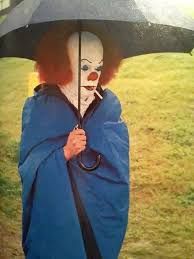
I was about 11 when Pennywise the Dancing Clown entered my life in earnest. A much cooler kid was having a sleepover for his birthday and his much cooler parents had let him rent three VHS tapes that I would never have had a chance of seeing at home: the 2000 'version you've never seen' re-release of The Exorcist, the 1998 remake of Carnival of Souls and the 1990 miniseries adaptation of Stephen King's IT.
Years earlier, a friend of my big sister had tried to scare me by telling me about "the clown that rips children's arms off" but it took the croaking performance from the late, great Tim Curry to truly embed the character my subconscious. Fastforwarding through all the 'boring bits', I'd be lying if I said that we properly watched any of the films (although both The Exorcist and the original Carnival of Souls would go on to become personal favourites). What I did catch, though was enough to change my life.
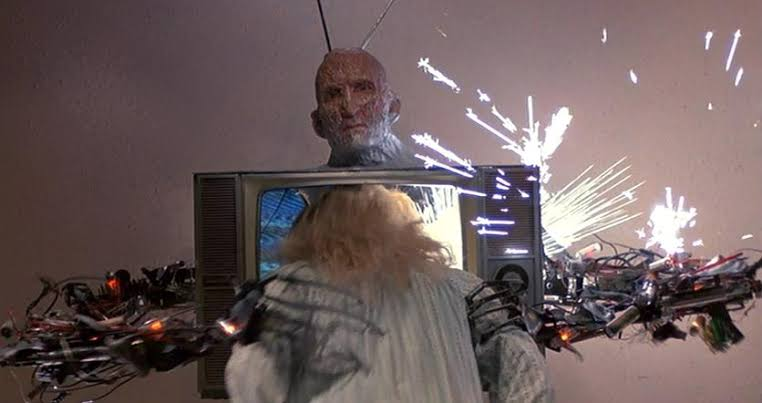
As Pennywise, a shapeshifting Lovecraftian demon whose default form is a clown, Curry is definitive. The costume he wears is mundane by necessity—partly due to the miniseries' low budget, partly due to Curry wanting to avoid prosthetics after a miserable time on the set of Legend. In theory, he should be no more scary than any other clown... until he turns up somewhere he shouldn't. Poking his head out of a stormdrain. Projected onto the moon. Popping up in my dreams. For decades, I have faced off against that demonic clown while I've been sleeping like a greasepaint-slathered Freddy Kruger and woken up to the sound of my own screams and the chill of my own sweat.
Since Curry passed away earlier this year, my nightmares have subbed in his Nordic successor, the gallingly un-scary Pennywise played by Bill Skarsgård since 2017. A massive downgrade to be sure, but I'm sleeping a bit easier now.
There's nothing mundane about the design of Skarsgård's Pennywise. Looking like one of those 'scary clown' masks that costume shops have sold since that spate of clown sightings in 2016, he is trying way too hard. And then there's the films around him, directed by Andy Muschietti. Without taking a moment to breathe or reflect across the two parts and relying heavily on sharp-toothed CGI monsters running jerkily at the characters, the films always go big when they should be going small. In my opinion, this is a low-point in the last decade of horror.
Some of you will probably think I'm being unfair. It's not like the 1990 miniseries had much going for it other than Curry and even he's not as scary to contemporary audiences. I showed a clip to my partner and she said "That's the guy you've been screaming at in your sleep?" The source material features some of Stephen King's best horror scenes but it's also the author at his most addicted: a sprawling work comprising 1,138 drug-fuelled pages and some truly questionable creative decisions. I haven't seen the 1998 Hindi-language adaptation Woh but I'm going to go out on a limb and say that there's never been an unimpeachable version of It.
Why on earth then am I watching the IT prequel series Welcome to Derry???
Derry Ghouls
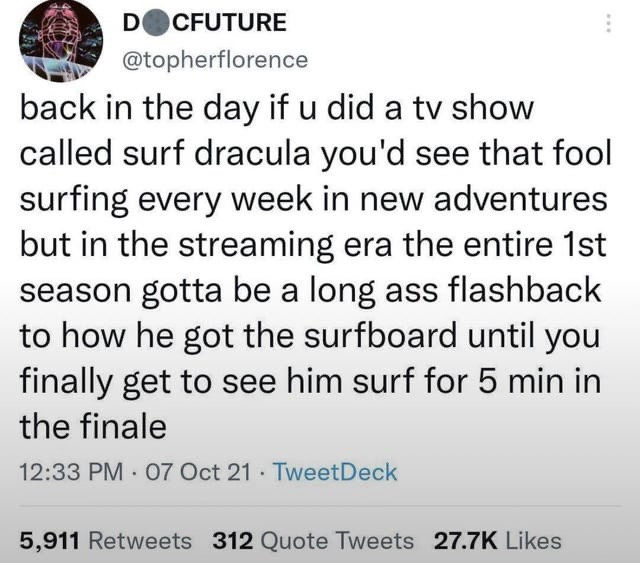
Pennywise might be a big reason for the endurance of this deeply flawed property, but he's not the only reason. It takes several episodes before the clown (Skarsgård again) shows up in Welcome to Derry like one of those Netflix originals where the superhero only puts on their costume at the end of the season.
Instead, what the show is most interested in, is the fictional town of Derry, Maine. King's novel and all its subsequent adaptations have hinged on the detail that the monster that takes the form of Pennywise awakens from its sleep every 27 years to feed on children. The town of Derry is a place where so many of the great sins of American history: racist pogroms, violent crime, child abuse, et al can be seen as the will of a sort of cosmic evil.
In both the book and miniseries, the narrative focuses on two key settings: children encountering Pennywise in the 1950s and then coming back to end him once and for all 27 years later in the 1980s. For his duology, Muschietti shifted this to the 1980s and 2010s respectively. Back as showrunner (blegh), each of Muschietti's seasons will tell the story of one of Pennywise's feeding frenzies, 27 years prior to the previous one. In the case of season one, that's 1962 (with season two taking place in 1935 etc etc).
I'm only halfway through the season and, I'm gonna be honest, it's pretty flawed! While the premise's potential lies in its ability explore the evil lurking under the surface of America across different moments in time, Muschietti is clearly uncomfortable with the mundane, small-stakes horror that made Curry's performance so effective. Instead, we get a massive Cold War story where the US military enlists Black soldiers with special abilities (like Hidden Figures) and Indigenous knowledge (like Windtalkers) so they can take control of Pennywise and unleash clown-themed WMDs on America's enemies (I'm not joking). Imagine, how the Bay of Pigs would have gone if the gusanos had been armed with magical banana cream pies? How would the Viet Cong have reacted if a tiny car rolled up to Thanh Hóa Bridge and like 1,000 green berets piled out of it?
I don't know if I'm going to get answers to these questions but I'm going to keep watching, even if it doesn't improve. Part of me has to keep battling the Pennywise inside me. Part of me is an absolute sucker for the premise.
Some places just have bad vibes
The major non-clown-related reason It has stayed with me is that I can't say no to a horror narrative set in a place haunted by violence that periodically becomes un-containable. The idea of a place haunted by its own history was one that informed my novella Downstream from Nowhere. And even if I'm not particularly superstitious, I can think of two distinct examples of places I've visited where the feeling of spiritual unrest was unshakeable.
The first was Launceston, Tasmania, easily the most unpleasant city I've ever visited. Arriving on a Sunday, the streets were completely empty, as if the residents knew something I didn't. It will surprise absolutely nobody with a passing knowledge of Tassie's history to know that the city's Federation architecture was built on the site of genocidal violence committed in the so-called 'Black War'.
The second was the island of Pulau Besar in Malaysia. There are tons of stories about this place, including a well where Japanese soldiers allegedly threw the heads of POWs in World War 2. Unlike Launceston, it's actually a really pretty spot even if the centuries of dead bodies beneath my feet were palpable.
As a film partisan, it pains me to admit that the longer-form nature of TV means that it is uniquely able to explore these kinds of ideas.
The trope of the 'Indian burial ground' is mostly thought of as a lazy, racist way of establishing a place as haunted (you better believe it comes up in Welcome to Derry) but you can see how it could be effective in the right hands given how much of the space we occupy is the site of genocide. IT really works despite itself because of this core idea. Having said that, I don't think Stephen King was thinking too coherently about America's shameful foundations when he invented Derry. In his lore, Pennywise arrived long before White people, landing in the spot that would become Maine in dinosaur times (maybe some brontosauruses were doing some Sodom and Gomorrah shit idk).
But there are plenty examples of talented writers (not Muschietti) taking this idea and making something truly interesting out of it. One that I can recommend without any caveats is Widow's Bay, created by Katie Dippold. A more comedic take on a town with terrible vibes, it takes place in a small New England island that has been battered by an absurd litany of horrors over the years. It's able to use the episodic format to do one-offs based on everything from Jaws, The Fog, Halloween, The Wicker Man and The VVitch. So far, we have heard that the horror stems from founder Richard Warren making a deal with an entity who dwelled under the ostensibly unpeopled island. Dippold has an opportunity in future seasons to explore whether or not Widow's Bay was actually 'terra nullius' when Warren arrived or whether he was complicit in something even nastier.
Think of the shows that have benefitted from 'zooming out' and adding to the lore in a way that feels completely historically appropriate. The best example is Twin Peaks in which season 3 introduced the idea that the evil that has haunted this town came into the world during the explosion of the first atomic bomb. Muschietti wishes he could weave together the horror of the nuclear bomb with the horror of the nuclear family as effectively as Lynch does in s03e08.
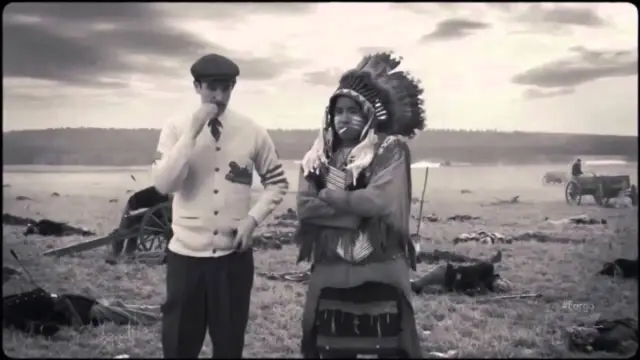
My personal favourite though is Fargo. The Coen Brothers' film, one of the best of the 1990s, presents the violence that erupts in Midwestern small towns as an unwelcome aberration. By building on this idea with an anthology where each season unfolds in a different year (2006, 1979, 2010, 1950, 2019 respectively), creator Noah Hawley is presenting violence as something more endemic to American life than people would like to admit. This theme comes through most effectively in season 2 (the best season) which opens with behind-the-scenes footage from a fake Ronald Reagan western Massacre at Sioux Falls, elegantly linking the Midwest's history of colonial violence with what is about to unfold.
What makes these shows so effective (even when they stubbornly refuse to be good), is not a red nosed boogeyman but their applicability to the spaces we inhibit. Whether we like to admit it or not, we're probably living in Derry, or Widow's Bay, or Twin Peaks, or Fargo, or Launceston, or Pulau Besar.
I may not regularly face off against the supernatural (anymore), but I do live in a city where a history that we'd like to keep buried regularly erupts from the pipes causing mahem and horror. That's why I'm going to keep holding out for Welcome to Derry to get good.